London Campuses of UK Universities

Students intending to study in the United Kingdom would be interested to know the London Campuses of UK Universities.

According to www.qaa.ac.uk most of the London Campuses were established between 2009 and 2014.  The main reason to establish them in London was to increase the recruitment of international students who would be more attracted to London than to the home campus.

The London campuses offer mainly postgraduate programmes in business, management, accountancy, tourism, law and computing with two offering PhD opportunities.

The 13 universities that have London campuses are listed below:

  1. Anglia Ruskin University
  2. Bangor University
  3. Coventry University
  4. University of Cumbria
  5. University of East Anglia
  6. Glasgow Caledonian University
  7. Glyndŵr University
  8. University of Liverpool
  9. Northumbria University
  10. University of South Wales
  11. University of Sunderland
  12. University of Ulster
  13. University of Wales Trinity Saint David

More recently, there have been proposals to develop courses in public health, architecture, forensic psychology and Irish studies.

PLAIN ENGLISH AND LAW

People at large expect plain insurance policies, plain tax forms, and plain health information.  Besides, there is a strong need for plain legal language to understand the Judgements from different courts, be it Trial Courts, High Court or Supreme Court which are running to hundreds and thousands of pages with a lot of Legal Jargons, etc.  The mammoth discussion papers and reports from Government Departments, Committees, Advisory Panels, etc.  make citizens’ life difficult, as the Reports are running to several hundred  pages.  It is really putting off even educated people, let alone ordinary citizen.  With the result, there is little feedback or comments from the people for whom these documents are written.

Why can’t various Laws, Judgements, Government Reports, etc., be brief, simple and in Plain English.

I am not sure if the Law Schools, as part of their Curriculum, teach Plain English or Plain Legal language.  I remember some years ago, the British Council in Chennai facilitated discussion and training on Plain English aimed at Legal community.

I am sure Plain English Campaign is already existing.  I wonder if Lawyers together with likeminded colleagues who are in discussion groups in various Social networks could take the Plain English Campaign to its logical end and ensure that the Law students at various law colleges and law schools are taught Plain legal language so that at least future generation will be dealing with simple, brief reports and judgements.  I hope Lawyers would not reject this suggestion saying that Plain Language is impossible because the law deals with complicated ideas that require a greater precision, which I think is a myth.

Like the Consumer movement, I think the Plain English Campaign should gain force.

I read recently, New Zealand, in some ways, has led the world in bringing the law closer to the ordinary citizen.

The UK Clinical Aptitude Test (UKCAT) for Medical and Dental Degrees

Are you intending to study Medicine/Dentistry at any of the UKCAT Universities for entry in 2016 then you should be aware of UKCAT, its format, Registration and how to prepare for the Test, etc.

The UK Clinical Aptitude Test (UKCAT) is used in the selection process by a consortium of UK University Medical and Dental Schools. The test helps universities to make more informed choices from amongst the many highly-qualified applicants who apply for their medical and dental degree programmes.

The 2015 UKCAT can be taken between 1 July 2015 and 6 October  2015Prospective students are strongly recommended to register and sit the UKCAT at their earliest convenience to ensure places are available at a local centre. (see elsewhere for Test Centre locations and Test Centre Locator).

UKCAT

Prospective candidates can check http://t.co/7SFhg66UUF to see if they are eligible for a Bursary to cover the full cost of their test.

Test Centre Locations

Candidates from the following countries must take the UKCAT.  Use the Test Centre Locator to find your nearest centre.

Afghanistan Ethiopia Luxembourg Singapore
Australia Finland Malawi Slovakia
Austria France Malaysia Slovenia
Bahamas Germany Maldives South Africa
Bahrain Ghana Malta South Korea
Bangladesh Gibraltar Mauritius Spain
Barbados Greece Mexico Sri Lanka
Belgium Hong Kong Morocco Swaziland
Bermuda Hungary Myanmar Sweden
Botswana Iceland Namibia Switzerland
Brazil India Nepal Taiwan
Brunei Indonesia Netherlands Tanzania
Bulgaria Iraq New Zealand Thailand
Cameroon Ireland (Republic of) Nigeria Trinidad & Tobago
Canada Israel Norway Turkey
Cayman Islands Italy Oman Uganda
Chile Jamaica Pakistan Ukraine
China Japan Philippines United Arab Emirates
Croatia Jordan Poland United Kingdom
Cyprus Kenya Portugal United States of America
Czech Republic Kuwait Puerto Rico Vietnam
Denmark Latvia Qatar Zambia
Ecuador Lebanon Romania Zimbabwe
Egypt Libya Russia
Estonia Lithuania Saudi Arabia

Source: http://www.ukcat.ac.uk/

Mumbai student won a Scholarship worth INR 2 Crore [.315 million US Dollars] to study at Cornell University

Only a few weeks ago we came across a news item about an Indian origin girl (Ms Pooja Chandrasekar) making history at the age of 17 by receiving University admission offers from 14 top US Universities, including 8 Ivy League universities with her academic and non-academic achievements.

We heard a couple of weeks ago yet another news that a student from Mumbai (Ms Bhavi Jagatia) at the age of 17 made another history by  securing Cornell University (Ivy League University) admission with a Scholarship worth Rs 2 Crore [0.315 Million US Dollars]  Congratulations from all of us to Ms Jagatia. Ms Jagatia will use this scholarship to study Aerospace engineering programme  to pursue her dream of becoming an Astronaut.  Once at Cornell, she has no dearth of grown-up role models, including the likes of Indian-American Astronauts Kalpana Chawla and Sunita Williams.

Both these achievements, I am sure, will motivate a lot of other students wanting to be star performers.

British Council MOOCs (Massive Open Online Course)

Free IELTS online course:

While there are a number of individuals and organizations offering coaching /facilitate training for IELTS (International English Language Testing System] aimed at students intending to study in overseas countries (including UK, USA, Canada, Australia, etc.),  I thought students and others interested in learning English,  should be aware of the new initiative from the British Council.

Effective 11 May 2015, the British Council and Future Learn together with its University partners have joined to facilitate students’ access to British Council English language content and assessment and offer six weeks free Online English language learner’s course called – Understanding IELTS: Techniques for English Language Tests.  Anyone can join, even up to the last day of the course, the next of which is scheduled on 21 June 2015.

Each week, the course focuses on one of the four skill components of the IELTS test (i.e. Reading, Listening, Writing and Speaking) and uses videos, test samples and quizzes to give students a greater understanding of the test format and help them get their best IELTS score.

At every stage there will be advice from their video tutors and a team of experienced IELTS educators.

The course is aimed at anyone:

  • Taking an IELTS test
  • Learning English
  • Looking to improve their IELTS score
  • Applying to universities in English-speaking countries.

Students can sign up at www.futurelearn.com/ielts

FutureLearn, is the UK’s social learning platform, wholly owned by the Open University, UK with the benefit of over 40 years of their experience in distance learning and online education.

The MOOCs are free, and can be assessed by students anywhere provided they have an internet connection.  Students can log in for their sessions on desktops, laptops and tablets.

On a related but different issue:

New UK Home Office’s requirements:

Applying for  a UK Visa: Approved English language tests

If the visa you are applying for asks you to prove your English language ability you should use the list of approved secure English language tests and test centres that meet the Home Office requirements.

Anyone who has taken a previously approved test on or before 5 April 2015 may still use it in a UK Immigration application until 5 November 2015 providing the test is one of those detailed in the transitional approved tests list.

Following link

https://www.gov.uk/government/publications/guidance-on-applying-for-uk-visa-approved-english-language-tests

provides both the lists, i.e.

  • List of approved tests and providers effective from 6 April 2015 and
  • Transitional list of approved tests and providers.

As you will notice, tests like TOEFL/IBT, Pearson Test of English (PTE) are not included in the approved list effective from 6 April 2015.

Innovative Integrated Master’s Programme

It is this month (ie. month of May), 12th class results get published in India and therefore I thought it is right time to share with those, who are not already aware of some of the innovative programmes on offer at Indian Universities.

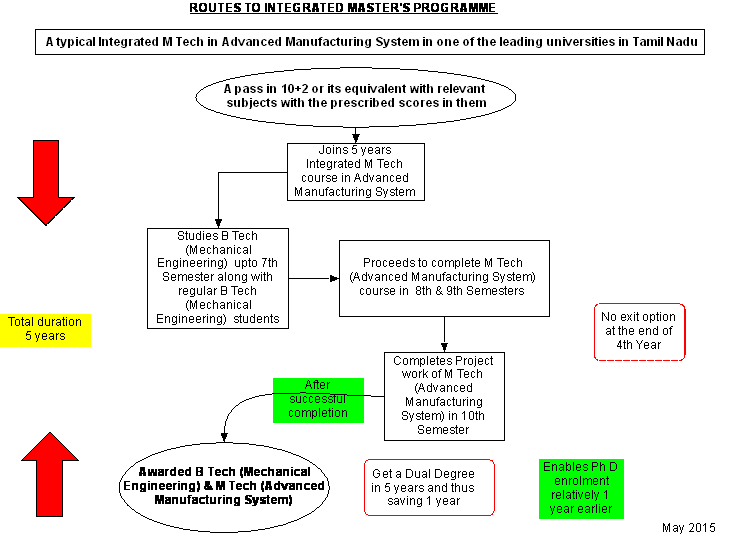
While we are all aware of the  Lateral entry to Undergraduate BE/BTech programmes through Polytechnic Diploma route, some of us are not aware of the Integrated Master’s degree programmes.  For e.g. successful 10+2 students could get admission into 5 years integrated MTech programme and save 1 year.  That is,  if a student wants to study for BTech and then  M Tech, he or she needs to study B Tech for 4 years and M Tech for 2 years.  However, this innovative Integrated programme enables students to qualify for M Tech in 5 years.  Using a Flowchart I have illustrated a typical Integrated Master’s Programme at one of the leading Private universities in Tamil Nadu.  The advantages are: (i) students are able to complete their Master’s programme in 5 years; (ii) obtain a Dual degree in 5 years; and (iii) should they wish to enrol for their Ph D programmes they can do it relatively one year earlier than other students, who take 6 years to enrol for their PhD programmes.

integrated

Besides, there are Universities offering Integrated Master’s degree programmes in other disciplines, as well.  For e.g. it is possible for a student to study BA LLB (Hons)  or  BBA LLB (Hons) or B Com LLB  (Hons) in 5 years as an Integrated Master’s programme. It is also possible for students to study for Integrated M Sc or Integrated MBA.

I hope this information will enable prospective students to be aware of innovative programmes like this so that they can take an informed decision while making applications for the academic year 2015-2016.

A new Blogger’s blogging experience

Though I have heard about the word “Blog” I never realized until a couple of weeks ago that I too can join the Club of “Bloggers” when my close friend from Boston said that I should go the Blog way when I discussed with him about a concept I had in mind.

I had been sharing, for  quite sometime, useful and relevant information with close friends and relatives.  For eg. I shared recently with them a few free Online courses targeted at Parents and students.   “Parenting in the Digital Age”  was one of the Massive Open Online Courses (MOOCs) and it was aimed at Parents.   [Incidentally, I will be contributing another blog post as to what is my understanding of MOOCs ].   The course content was very relevant for Parents, especially when the kids spend a relatively more time with modern Gadgets – Smartphones, gaming systems, ipads,  ipods, tablets or other digital devices.  With access to the Internet, these devices allow children to connect to others in ways we never could have imagined. With the proliferation of these devices comes the concerns about Cyberbulling,   media literacy, and exposure to inappropriate content.   I thought I should share the details of this course with Parents, who otherwise would have missed it.   Because, for Parents, keeping up with their children’s use of technology can be a daunting challenge.  A few of the questions this course attempted to explore were:  what can parents do to help use these devices responsibly? when online, how can Parents make sure their children are safe? What can Parents do to prevent the sharing of personally identifiable information? Parents would hugely benefit from courses like this and in turn can help their children with a view to guiding them effectively.

There was yet another occasion when I shared a news item with my friends and relatives.  An Indian origin girl (Viirginia born) made history  by receiving University admission offers from 14 top US Universities, including 8 Ivy League universities.  Her academic and non-academic achievements made her to become so famous at the age of 17.  I thought this should be shared with those involved in children’s education, so that the children get motivated and follow this girl’s foot steps.

As I am passionate about sharing this kind of information or news item and as I wanted to share them with a wider audience, I started putting my ideas and thoughts together on how best I should take this forward to its logical conclusion.  I captured my ideas using a Mindmap   and shared it with my friend and sought his feedback.  [I will be contributing yet another blog post as to how I benefitted from Mindmaps  tool to collect and share my thoughts]. It was in this context my friend suggested that Blog is a good candidate for this purpose and he suggested that I read more about Blogs and blogging.

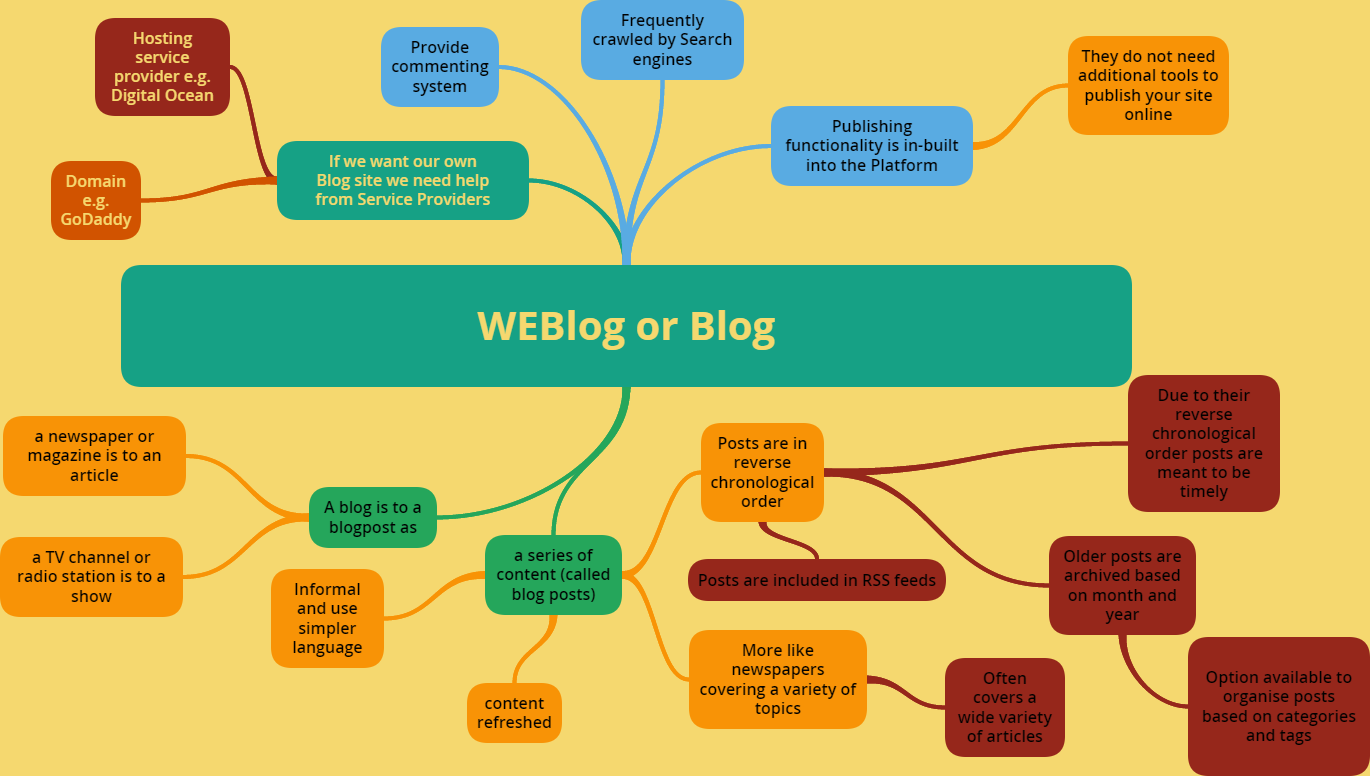
I have illustrated below my understanding of Blog. My understanding is based on the sources available on Public Domain.  As I have a tendency to understand and appreciate illustrations much better than in a descriptive format,  I preferred Mindmap for this illustration.

I welcome your feedback. Thanks.

WEBlog or Blog

Hello world! PRO-ACTIVE INFORMATION DISSEMINATION SERVICE

For quite some time now I have been providing information service to my close friends and relatives and it was in an ad-hoc manner. With my professional experience in the provision of pro-active information service, I thought I should take this forward to its logical conclusion by sharing information to all, who will benefit from such a service.  That was how I got the idea to have my own Blog Page.