Hierarchy of Courts in India

People like me, who are not familiar with the hierarchy of Courts in India, especially, those courts, which are subordinate to High Courts, might find the following Post helpful.

Like we are expected to be familiar with our Fundamental Rights and have basic knowledge of law, we should be clear, as well, in our understanding in so far as different courts were concerned.

When we read/watch news items in print and/or media, about civil and criminal cases, especially at courts, which are sub-ordinate to High Courts some of us are a bit confused as we are not aware of the structure and thus have difficulty in understanding and sometimes find it hard in putting the news in context – as there are different courts existing both at District and Metropolitan levels –e.g. District Court, City Civil Court, Sessions Court, Metropolitan Magistrate court, Judicial Magistrate Court (I Class), Judicial Magistrate (II class), etc., presided byDistrict Judge, Principal Judge, Sessions Judge, Metropolitan Magistrate, Judicial Magistrate, etc.

For instance, the headline news “District courts have 10-year backlog” in Hindu newspaper, as recent as 27 September 2015 – the news item, quoting National Judicial Data Grid states that “there are 2 crore (20 million) cases pending before district courts across the country as on 25 September 2015 and two-thirds of them were criminal cases; ten per cent of these cases had been pending for more than 10 years……”.

What are these Courts with so much backlog ?

The highest court in each district is the District and Sessions Court.  When it exercises its jurisdiction on Code of Civil Procedures it is called District Civil Court.  The District court is also a court of Sessions when it exercises its jurisdiction on criminal matters under Code of Criminal Procedure.

The District and Sessions Judge is often referred to as “District Judge” when he/she presides over civil matters and “Sessions Judge” when he/she presides over criminal matters.

The District Judge is also called “Metropolitan Sessions Judge” when he/she is presiding over a district court in a city which is designated “Metropolitan area” by the State Government(Source:Wikipedia)

Though it looks that we have too much to digest, the Flowchart below would enable us to (i) clarify/confirm our understanding and (ii) put the recent news in context.

When I tried to educate myself using the information available on the Internet, I came across a few Flowcharts illustrating the hierarchy of Courts in India. They were not that user friendly, at least for layperson, amateurs like some of us. Therefore I thought a simpler version would go a long way in enabling non-professionals like me understand the hierarchy better.A clear understanding of the structure would enable us to know, subsequently, the roles of these different courts, as well.

This Flowchart is based on my understanding of the hierarchy of Courts in India.

As you will see, this simple Flowchart illustrates sub-ordinate courts– both Civil and Criminal courts – at (i) Metropolitan and (ii) District levels.Besides, it illustrates the hierarchy in terms of (i) Labor Courts and (ii) Family Courts together with specialized tribunals.

Flowchart 1:

Flowchart 1

The above Flowchart focuses the subordinate courts by Metropolitan and District levels.  However, if required, the hierarchy can be illustrated in a different manner for those who want to have the structure by (i) Civil Courtsat (a) Metropolitan and (b) District levels and (ii) Criminal Courts at (a) Metropolitan and (b) District levels. i.e.

Flowchart 2:

 Flowchart 2

As you will see, Flowchart 2 is incomplete, as it was just to show that the hierarchy can be illustrated differently. Those who like the Flowchart 2 can complete it using the inputs in Flowchart 1.

As I mentioned earlier this is a simple Flowchart.   There may well be others who have looked at the hierarchy more comprehensively and attempted to capture all relevant details on a Flowchart including Revenue Courts, Consumer Courts, Trial Courts, etc.   As I am not clear on how these courts relate themselves on the hierarchy, I would love to learn and benefit from those who have relatively better understanding of the structure.

Music Librarianship

Image 1

I am sharing, through this Post, my experiences and the lessons I learnt recently.

As an information scientist by profession, rendering professional services to a high profile Music College in Chennai was hugely rewarding and a challenging experience, as well.

Rewarding, because it was an opportunity to be a Library Practitioner again (after having retired from the British Council Library a few years ago) and render professional services to a library at a Music Conservatory, namely KM Music Conservatory (KMMC) (http://kmmc.in/home/the-conservatory/),  founded by Oscar Winner and Music Maestro Dr A R Rahman.  Something for me to cherish forever.

Challenging, because (i) to classify entire music resources – a little over 1400 documents including Hindustani & Western Music books, CDs and DVDs; (ii) to make these documents shelf ready in so far as generating spine labels with the class number thus assigned for these documents –  more so,  achieving these two tasks in about 2 months’ time (ii) while music literature can be classified following general classification schemes that apply to all subjects, music scores present unique challenges of both description and access.  Examples include uniform titles, responsibility (composer versus performer), etc.

In colleges or Universities, where music is only one aspect of academic focus, the music collection may be integrated into the greater library system, or a separate collection from the main library. At academic institutions dedicated to music, such as KM Music Conservatory, the music library is the main library collection of the Conservatory. In British Council Library, where I worked for over two decades, the music collection was part of a bigger library system.  My experience at the British Council library was mainly on (i) managing the library and its resources for South India, (ii) marketing library services, (iii) managing customer relationship, (iv) managing Events, etc.  Whereas, my brief experience at KMMC was unique in terms of classifying myself so many documents exclusively on Music.  I considered this as a great opportunity for my Continuing Professional Development (CPD) in terms of (i) refreshing my professional knowledge & gaining new experience of classifying huge music resources and (ii) to practice and further improve my core professional librarianship skills.

The library collection at KMMC was geared to meet the information needs of Faculty members and students studying Preparatory, Foundation and Diploma courses in Music, Audio Engineering, Electronic Music Production, etc.  Successful Diploma students have the option of progressing onto their Degree program at Middlesex University in London under an articulation and collaborative agreement between KMMC and Middlesex University, London.

It was OCLC (Online Computer Library Center, Inc) which helped me to overcome the challenges.  It was a great experience accessing WorldCat (https://www.worldcat.org/) –the largest Online Public Access Catalog (OPAC) in the world.

OCLC (Online Computer Library Centre, Inc):  OCLC is “a nonprofit, membership, computer library service and research organization dedicated to the public purposes of furthering access to the world’s information and reducing information costs”.  Founded in 1967 as the Ohio College Library Center, OCLC and its member libraries cooperatively produce and maintain WorldCat (Source: Wikipedia)

As it was only in 2006, the WorldCat.org search box went live, i.e. offering access to WorldCat to online information seekers, I never had the opportunity to access and take advantage of it during my British Council days, as I left the British Council Library services in 2002.

Image 2

However, I am happy that I was able to access WorldCat recently at KMMC library. It was immensely helpful in (i) quality reviewing KMCC’s Library holdings list in terms of ensuring the list included correct Author name (both Surname and Forename), title, edition and volume statements, Publisher, year of publication, ISBN / ISMN, etc. (ii) to make sure that there are no errors of judgment during the classification process and in assigning class numbers; (iii) creating list of books and bibliographies, etc.

WorldCat connects us to the collections and services of more than 10,000 libraries worldwide; through the WorldCat one can access two billion items held in member libraries of OCLC. I understand it grows steadily every day from the contributions of member libraries in the OCLC co-operative.

WorldCat can be accessed by anyone from anywhere with good internet access and those who have registered themselves will be able to create lists, bibliographies and reviews of library materials.  Besides, reviews help in library collection development including books, CDs & DVDs; [Learning Point 1]

I realized that a Librarian using WorldCat could provide a lot of proactive information and Current Awareness services. [Learning Point 2]

Incidentally, from the comforts of home/office and by using WorldCat,  it is possible for those in Europe, Middle East, North America, Australia and New Zealand to  find out if a particular book which they were looking for is available in a library located nearer home/office.  It isalso possible for them to borrow books, on returnable basis, from other participating libraries, just in case a book is not available in a library nearer home/office.   As, barring a handful of libraries, the rest of the participating libraries in OCLC Project, lend books on returnable basis to overseas participating libraries.  [Learning Point 3]

The other resource which I found useful was “OCLC Classify” – an experimental classification web service (http://classify.oclc.org/classify2/) .The database provides access to more than 91 million classification numbers and support in providing subject headings for books, DVDs, CDs, etc. I am happy to share that one of my suggestions was considered favorably by “OCLC Classify” and the same was implemented by OCLC as far as a Class number of a particular book was concerned.  Using this resource was a big learning experience for me. [Learning Point 4]

I take this opportunity to remember and thank both Dr D B Krishna Rao (Prof & Head) and Prof P Gangadhara Rao (Reader), Department of Library and Information Science, University of Madras – my respected teachers (unfortunately, they live no more), without whose support and encouragement I would not have done well in my Post graduate degree in Library and Information Science, especially Classification Theory and Practice.  The knowledge & training imparted by them a few decades ago is still fresh in my memory and it helped me hugely in classifying so many books within a short period of time.

Music OCLC Users Group (MOUG):  MOUG provides an official means of communication and assistance for users of the products and services of OCLC. Though I did not take advantage of the Users Group, I thought I should mention it here.

Copyright & Fair use:

While surfing the Internet for Music online, I realized that Copyright is a major issue in this field.  As music copyright is an intricate issue, music Librarians’ must carefully abide by copyright guidelines.

This was also a wonderful opportunity for me to read more about (i) Copyright & Fair use and (ii) Public Domain, which enabled me to clear some of the misconceptions I had about them.  For example, (i) the fact that something is posted on the Internet does not give us the right to copy and distribute it freely; most material found on the internet is protected just like any other material [unless otherwise indicated]; (ii) if the use is not a personal one, it may not be permitted to download and use in any manner any video on You Tube, any music from iTunes.  [Learning Point 5

Music librarians deal with standard librarianship duties such as cataloging and reference, but as I mentioned earlier, the addition of music scores and recordings to collections complicates these tasks.  Therefore, besides having a professional degree in Library and Information Science, either knowledge of music or a basic degree in music would go a long way in adding value.  It would be beneficial if students study Dual honours degree programs, i.e. for example, studying two degree subjects in equal amounts, as offered at University of Keele, in the UK.  If someone wanting to have a career as Music Librarian, he/she could study Music together with another degree subject before getting professionally trained through a Master’s course in Library and Information Science. Massive Open Online Courses (MOOCs) could be another option for those Librarians who cannot spare time to do a full-time course in Music.  Online course “Introduction to Music theory” offered by Berklee College of Music https://www.berklee.edu/ is just an example.

My value contribution would have been relatively better if I had knowledge of music or a basic degree in music.

Knowing  one or two European languages is yet another asset for Music Librarians, as it would be highly useful when dealing with music books,CDs and DVDs from top Composers of all time from Europe– Johann Sebastian Bach (German); Wolfgang Amadeus Mozart (Austrian); Ludwig van Beethoven (German); Franz Schubert (Austrian); Claude Debussy (French); Antonio Vivaldi (Italian); Felix Mendelssohn (German); Franz Liszt (Hungarian); Gustav Mahler (Austrian); Johannes Brahms (German), etc.

Amazon

I understand libraries that buy books and other materials from Amazon.com will automatically receive corresponding catalog record delivered from OCLC, have their holdings set in WorldCat, and receive labels from Amazon.com.

As OCLC is following only DDC (Dewey Decimal Classification) and Library of Congress (LC) schemes, I wonder what happens to libraries following Classification schemes other than DDC and LC Classification Schemes? Would OCLC be able to deliver catalog records according to the Classification Scheme followed by a particular library, should the Library decide to buy books from Amazon and be part of OCLC cooperative project.  For example, the University of Madras is following Dr S R Ranganathan’s Colon Classification (CC) Scheme and if I remember correct, Indian Institute of Technology (IIT), Madras is following UDC (Universal Decimal Classification) System.  Would the catalog records and the labels be according to CC Scheme and UDC respectively?  I am in the process of checking with OCLC regarding this.  In the meantime, would love to hear from people, who have information or views on this.

Sorry for this lengthy Post.

Congratulations to Mr Sundar Pichai

Our congratulations to Mr Sundar Pichai.  An enviable and illustrious academic and professional career. The motivational facts of Mr Sundar Pichai are – though he is a Global CEO now, he is a simple, hardworking, down-to-earth and unassuming person.  One of the most popular bosses at Google, as well as a good team player and team leader.  I wish our youngsters who want to achieve big in life should consider having him as one of their role models.  In my learning process and seeking and searching information for my provision of proactive information service, I use Google Chrome browser extensively and I thank Google in general and Mr Sundar Pichai in particular, as it  is Mr Sundar Pichai, who was responsible for driving Google’s Chrome OS and Browser to the fore.  As we all know, Chrome is the leading web Browser in the world now, displacing Microsoft’s Internet Explorer, which dominated the market for decades.

In my view we should think beyond the Brian drain , as Mr Sundar Pichai’s contribution in terms of Chrome Browser is benefitting millions of people around the world and thus we are proud of him – as a Global CEO for a Global village in so far as the Internet is concerned.

Yet another American Indian was in the news recently.  I do not know if this was for good reason or otherwise.  Mr Aran Khanna – third year Harvard student loosing Facebook internship for exposing privacy flaw.   According to the news item, Mr Khanna created a Chrome Browser extension that appeared to capitalize on a “Privacy flaw that Facebook had been aware of for about three years and this was the Messenger application’s automatic sharing of users’ locations with anyone who they messaged”.

Like many users of Internet and various browsers, I too hope and wish that the service providers use or take advantage with the various information and details they collect only for constructive purposes, safety and security of the nation and its people and not otherwise.

Our way of remembering and paying tribute to Dr A P J Abdul Kalam

It has been little over a week now since we lost our “People’s President”.  We have been going through all kinds of emotions since Dr Kalam’s demise.  We are blessed to have lived during the times of Dr Kalam.

The Facebook and WhatsApp are flooded with messages, forwards, photographs, tributes, wish list in terms of what we want the Government and Government departments to do in memory of Dr Kalam.

These are all mostly from young people and students – Dr Kalam’s target audience, who are active in Social networks.

As of now the wish list includes:

  • Memorial at Rameshwaram like the one at Kanyakumari in honour of Sri Vivekananda
  • Dr Kalam’s image in Currency notes like Mahatma Gandhi
  • University in the name of Dr Kalam
  • Postal stamp honouring Dr Kalam [Dept of Posts has already confirmed that there will be a commemorative stamp in honour of Dr Kalam]
  • Introducing a course on his Biography in the School syllabus
  • Instituting awards in his name for perpetuating excellence in science and technology in institutes of higher learning

The list goes on.  It is fine.  These are all the demands we are putting forward to State and Central Governments.  As we all know,   it takes a lot of time for all these things to be in place.  Perhaps, it may or may not happen before Dr Kalam’s first death Anniversary.

Incidentally, it was good that the Tamil Nadu Government has already instituted an Award in Dr Kalam’s name and said his birthday, 15 October would be observed as “Youth Awakening Day” every year.

It was heartening to note that an Auto driver gave free ride in his auto rickshaw on 30 July.   Commercial establishments closed their businesses on that day. Cinema houses closed too on that day.

According to a post in Facebook, SBI staff worked on Sunday 2 August 2015 to pay tribute to Dr Kalam.   I read in the newspaper that Madras High Court is working this week for 15 minutes extra in the evening.

I understand some of the Government departments in Kerala worked on Sunday 2 August 2015 and a few other Government departments would work on Second Saturday, i.e. 8 August 2015.

There may well be others paying tributes in a fitting manner.

While the Governments at the State and Centre are making their own efforts to ensure what they can do, we should tell the world regarding our contribution in memory of Dr Kalam.

We the public have not come forward with anything to match. No one has said what he/she would do by way of tribute to Dr Kalam.  That is, how we are going to follow Dr Kalam’s advice and be a responsible citizen of India.

We should tell the people concerned or the Lawmakers that we are not going to stop with just sharing and forwarding messages in Social networks. We should demonstrate that we are serious in taking forward Dr Kalam’s advice.

Perhaps, from Dr Kalam’s messages, quotes, etc., I think we can draw our own list of objectives for us to achieve. Our commitment needs to be demonstrated, otherwise we will be criticised that we only make demands.

Perhaps each one of us could think of 10 objectives to start with.  Besides, we should encourage our friends and relatives to have their own objectives, as well.

The following is a suggested list and it is neither comprehensive nor in any priority order:

  • Spend quality time daily with our children and grand children, as appropriate. I wish to bring to your attention a recent Post in Linkedin titled Your Child’s potential depends on academic leadership–“Leading a business, organisation, or government is hard but it is not the toughest leadership job.  The toughest leadership job of all is parenting – coaching, teaching, mentoring – any leadership role that involves developing young people, including your own children, so they can reach their full potential”.  ……………adding to the challenge is the danger of wasting potential while leading adolescents………… a crime greater than with any other group in any other leadership role.  There is nothing worse than a young person wasting potential”.
  • Read x number of books including Classics and Dr Kalam’s books.
  • Visit our School/College and meet our teachers to thank and pay respect to them
  • Visit our Parents/in-laws , at regular intervals, if they are living elsewhere
  • Discourage relatives/friends from smoking & consuming alcohol
  • Be kind to others
  • Plant x number of trees
  • Obey traffic rules [it is unfortunate that many of us do not stop at “stop line”]
  • Do not indulge in drunken driving
  • Avoid using mobile phone while driving
  • Do not allow our children below 18 years old to drive scooter, motorcycle or car [we see of late a lot of youngsters who are below 18 years age driving scooters and motorcycles posing a huge risk to themselves and other road users]
  • Do not waste water [this has become already a scarce commodity, at least in Chennai]
  • Do not waste food
  • Have the culture of queuing
  • Conserve energy, especially electricity both at home and in offices [as we all know, energy saved is energy produced without any environmental degradation][Useful tips on energy saving in home appliances and electricity safety given at http://www.mercindia.org.in/pdf/TIPS_ON_ENERGY_SAVING.pdf%5D
  • Review the Rain Water Harvesting (RWH) structure in our homes/offices [ideal to do it well before the monsoon starts]

As I said the list is not exhaustive, just an example.  I am sure people can come up with their own lists.  We all can share our lists so that others can add to their lists, should there be something missing in their lists or something new to add.  The multiplier effect would be huge and enormous if those on Facebook, WhatsApp, Twitter, etc., cascade this. I understand Dr Kalam had more than 1.4 million followers on his Twitter account.

Most of them are simple and easy for us all to follow.  These simple steps would help us all to work towards achieving Dr Kalam’s 10 Points (see below…)

Dr Kalam’s 10 Points (Oath for the Students and Youth)

  1. I will have a goal and work hard to achieve that goal. I realise that small aim is a crime;
  2. I will work with integrity and succeed with integrity;
  3. I will be a good member of my family, a good member of the Society, a good member of the Nation and a good member of the World;
  4. I will always try to save or better someone’s life, without any discrimination of caste, creed, language, religion or State. Wherever I am, a thought will always come to my mind.  That is “What can I give?”
  5. I will always protect and enhance the dignity of every human life without any bias;
  6. I will always remember the importance of time. My motto will be “Let not my winged days, be spent in vain”;
  7. I will always work for clean plant Earth and clean energy;
  8. As a youth of my Nation, I will work and work with courage to achieve success in all my tasks and enjoy the success of others;
  9. I am as young as my faith and as old as my doubt. Hence, I will light up then, the lamp of faith in my heart;
  10. My National Flag flies in my heart and I will bring glory to my Nation.

For those of us who are not already aware:  since February 2011, Dr Kalam had been regularly posting his views on contemporary issues facing the country besides sending out inspirational messages on Twitter.  I understand, in memory of Dr Kalam,  former President’s Twitter account to remain alive in the new form.  Let us await the details.

The Rhodes Scholarships 2016

The Rhodes Scholarships, named after Cecil John Rhodes, is an international postgraduate award for selected foreign students to study at the University of Oxford. It is widely regarded as “the most prestigious scholarship” in the world.  Established in 1902, it was the first large-scale programme of international scholarships.

Rhodes Scholars may study any full-time postgraduate course offered by the university, whether a taught master’s programme, a research degree, or a second undergraduate degree (senior status). In the first instance, the scholarship is awarded for two years. However, it may also be held for one year or three years. Applications for a third year are considered during the course of the second year.

Each scholarship covers all University and College fees, a personal monthly stipend to cover accommodation and living expenses and one economy class airfare to Oxford at the start of the scholarship as well as an economy flight back to the student’s home country at the conclusion of the scholarship.

The following diagram illustrates the application procedures for Rhodes Scholarships India Programme

Rhodes Scholarship 2016 amended final

Some of the Rhodes Scholars from India:

  • Mr Girish Karnard, Playwright, Film Director and Screenwriter;
  • Mr Montek Singh Ahluwalia, Indian Economist, First Independent evaluator of IMF; former Deputy Chairman, Planning Commission, Government of India;
  • Ms Sagarika Ghose, Indian Journalist, news anchor and author.

Just in case you are not already aware, both former President of United States of America (Mr Bill Clinton) and the Republican Presidential aspirant (Mr Bobby Jindal) are Rhodes Scholars.

Students wanting to join the impressive list of Rhodes Scholars would be keen to take advantage of The Rhodes Scholarships 2016, should they find suitable courses at University of Oxford.  As you will see from the Diagram, the closing date to submit application form is 31 July 2015.

Wish you good luck.

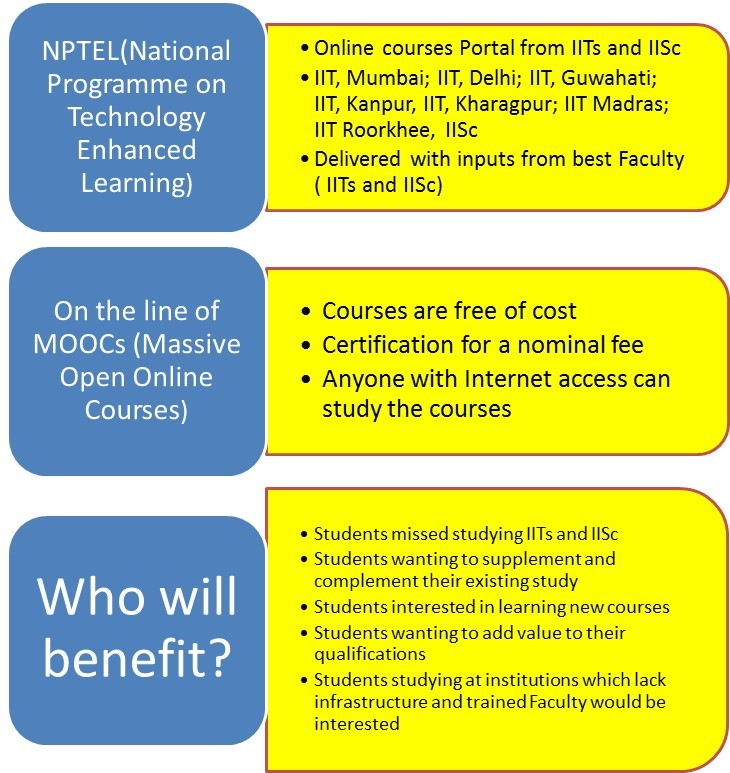
ONLINE PORTAL FROM IITs and IISc ON THE LINES OF MOOCs

Courses are  offered through an Online course Portal launched by IITs and IISc.  This is an initiative of  National Programme on Technology Enhanced Learning.

NPTEL is the joint initiative of :

  • IIT, Bombay
  • IIT, Delhi
  • IIT, Guwahati
  • IIT, Kanpur
  • IIT, Kharagpur
  • IIT, Madras
  • IIT, Roorkee
  • Indian Institute of Science (IISc)

https://onlinecourses.nptel.ac.in

Visit the above link and click on a course name to see more details about it.  You will need to log in to register for any course. After the registration you will be able to see the course contents as and when they are made available by the Course instructors.

As you will see, the courses are delivered by experienced and reputed academics.

The courses are free for anyone with access to the Internet.  Besides taking advantage of the courses, it is possible to obtain a Certificate, as well,  by paying a nominal fee.

Incidentally, this kind of opportunity never existed until a year ago.

NPTEL png

Some of the forthcoming courses are:

  • Computer science;
  • Aerospace Engineering;
  • Electrical Engineering;
  • Metallurgical Engineering and
  • Management sciences.

Examination for these courses is scheduled to be held in September and November 2015.

IIT Madras Graduates showcasing their love for the City of Chennai

The ultimate public transportation mobile application for commuters in Chennai

Most of the IIT (Indian Institute of Technology) graduates (if not all) proceed to USA for higher studies and job, as USA is a land of opportunities.

But we must congratulate and thank the three IIT Graduates, namely (i) Mr Siddharth Krishnaswamy, (ii) Mr Akilesh Koppineni and (iii) Mr Krishna Chaitanya who decided to team up to have a start-up with a view to showcasing their love for the City of Chennai. .

Thus, we the Chennai residents should be more grateful to these Graduates, as their dream project is benefitting us in a big way.   Raft – A public transport mobile application, which launched recently, is the outcome of their hard work out of an office space at the IIT Madras Research Park.  The app has more than 50,000+ downloads already.   The App gives the user the best routes to take between any two points in the city, using up-to-date timings of buses and trains

Covers all modes of public transportation options including MTC buses, Local trains, MRTS.  For now, the three are waiting for the Chennai Metro Rail Limited (CMRL) to start operations.  If we go by the news item recently on TV Channels, the Chennai Metro rail is scheduled to start its operations in Chennai on 10 July 2015 and thus the Raft will be updated to include Metro rail timings, as well.

According to the Graduates, efforts are on to branch out to other cities. We wish them a huge success with their efforts.

It was unfortunate that IIT-M (Indian Institute of Technology, Madras) was in the news in connection with Ambedkar Periyar Study Circle – the student body that was suspended on 22 May 2015.  Fortunately, the problem is sorted out with IIT-M lifting the ban on 8 June 2015.  However, there was a lot of tension, anxiety which I am sure would have affected to a certain extent the academic and research activities at IIT-M.  I personally feel Politicians should keep themselves off from academic institutions in general and premier institutions like IIT in particular and allow them to continue to carry out their teaching and research activities without any hindrance.  At least in future, let the Politicians leave it to the Institution and students themselves to sort out the differences, if any.

The outcome of the dream project by the three IITM Graduates is a classic example of the transfer of their knowledge leading to the mobile application, which is hugely benefitting the commuters in Chennai.

UK VISAS

National Health Service (NHS) Surcharge introduced

Life is becoming increasingly difficult for applicants intending to apply for UK visas.  Effective from 6 April 2015, there is yet another step before applying for Visas.  That is all applicants from countries outside of the European Union now need to pre-pay for National Health Service (NHS) charges before they submit their visa application.

You will have to pay:

  • Pounds 150 per year as a student
  • Pounds 200 per year for all other visa and immigration applications

If you have any dependents, they will usually need to pay the same amount as you.  The exact amount you have to pay depends on how much leave you are granted.  For more details, please visit  The UK Government immigration healthcare pages .

Applicants must pay the surcharge for themselves and any dependents before they submit their visa application (or book an appointment at a public enquiry office). Applicants must register and pay online.

Biometric Residence Permits (BPRs)
Successful applicants for a visa to enter the UK for more than six months will receive a Biometric Residence Permit (BRP) upon arrival in the UK.  They will be issued with a vignette in their Passport which is valid for 30 days from the date they indicate as their intended travel date in their visa application.  The vignette is proof only of the student’s permission to enter the UK and will allow them to travel to the UK.

Students then need to collect the BRP on arrival in the UK.  The BRP is proof of the holder’s right to stay, work or study in the UK.

Full details can be found in the Home Office overseas BRP leaflet (PDF 498 KB)

Applicants are strongly advised to visit the website UK Visas and Immigration (UKVI) for the most up-to-date visa rules  before they make a visa application.

Quality Assurance Agency and Published Rankings in the United Kingdom

If not all, some of us are aware that the UK Government does not have a ranking system for its Universities. If this is the case, then one wonders what are these ranking tables published by Guardian, Times, etc.

I thought Prospective students and Parents, who are not already aware  would appreciate this Post, which illustrates what (i) the UK Government’s stand on ranking system and  (ii) ranking tables published by Independent agencies, such as Guardian, Times, etc. especially at a time when  the Guardian has published recently its University Guide 2016.

Quality Assurance Agency (QAA):

The UK has a well-deserved reputation world-wide for providing high quality and well-respected higher education. There are well over 100 institutions in the UK that are permitted to award a wide variety of degrees to suit most educational aspirations.  All those institutions have degree awarding powers recognised by the UK authorities (UK and Scottish Parliament, Welsh and Northern Ireland Assemblies).

In addition to institutions awarding degrees, there are also several hundred colleges and other institutions which do not have degree-awarding powers but who provide complete courses leading to recognised UK degrees. Courses at these institutions are validated by institutions which have degree awarding powers.

However, universities and their courses are independently assessed by QAA (Quality Assurance Agency). These reviews contain judgements on whether standards, quality and the information an institution provides about itself have met UK expectations and the reviews can be found on the QAA website.

The UK authorities recognise those institutions which have been granted degree-awarding powers by a Royal Charter, Act of Parliament or the Privy Council.  These are known as ‘recognised bodies’. All UK universities and some higher education colleges are recognised bodies. Other institutions, which do not have the power to award their own degrees, may provide full courses which lead to a degree of a recognised body. These are known as ‘listed bodies’.

Source: https://www.gov.uk/recognised-uk-degrees

Published Rankings:

Guardian University Guide 2016

http://www.theguardian.com/education/datablog/2015/may/26/guardian-university-guide-2016-download-full-tables

This Guide includes an Overall Ranking of Universities and 53 Tables for each subject area.

According to Wikipedia, three national rankings of universities in the United Kingdom are published annually – by The Complete University Guide, The Guardian and jointly by The Times and The Sunday Times. Rankings have also been produced in the past by The Daily Telegraph and the Financial Times.

The primary aim of the rankings is to inform potential undergraduate applicants about UK universities based on a range of criteria, including entry standards, student satisfaction, staff/student ratio, academic services and facilities expenditure per student, research quality, proportion of Firsts and 2:1s, completion rates and student destinations. All of the league tables also rank universities on their strength in individual subjects. There is loads of advice for students thinking of going to university on the Guardian Students site.

The tables have been compiled for the Guardian by Intelligent Metrix, an independent consultancy that specialises in measuring performance in higher education. The rankings are based on official data collected by the Higher Education Statistics Agency (Hesa) and on the National Student Survey, published by Hefce.

Prospective students – Good luck with finding your perfect course.